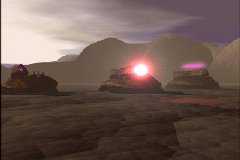
 Overview Overview
"Dominate the new world ... War, famine and pestilence have combined
with ecological collapse, genetic manipulation and tectonic disaster to
bring about the demise of the world we now know. The aftermath of this
destruction has caused mankind to splinter into eight opposing clans and
necessitated the construction of huge spaceships to search the galaxy for
habitable planets. Once a planet has been deemed habitable, a mechanized
commander, a brain in an android body, must be sent down to the planet to
survey, colonize and defend the planet for the arrival of the clan.
"M.A.X. features twenty-four different worlds and eight
different clans, each with its own advanced artificial intelligence and
endless replayability with customizable units, battlefields, scenarios and
campaigns. A tutorial and user-friendly interface with pop-up menus
detailing individual unit functions and abilities."
This is the setting for M.A.X., the newest entry in the
heavily scarred battlefield of action strategy games. You may be
wondering: "Does this game have a chance facing off against big players
like Red
Alert ?" To answer your question, Red Alert better run
for cover, 'cause the flak's gonna come raining down from this one.
M.A.X. is a very competitive title, filled with enough
innovation, customization and destruction to make you one happy general.
The game has so many improvements over standard fare in the genre, I was
amazed that it was not a sequel. It has a few minor setbacks, but all in
all, this is one incredible game.
Interface
The first thing you notice about the game (once you get past the
beautifully rendered opening and cut scenes, that is) is the interface.
Not only are all the necessary buttons within reach, but there is an
incredible degree of customization. The game lets you toggle just about
any display option imaginable, including how far units can shoot and see,
the mineral potentials in the ground, unit status, color, ammo level,
movement available, etc. In addition, the screen offers a FULL zoom
feature. In other words, not only does this game give you multiple
resolution levels, but you can literally zoom a fraction at a time from a
total zoom in, showing just a couple of units (in very high definition) to
a full zoom out, showing the entire map in one screen. This alone was
incredible to me, and I found myself adjusting the zoom several times
throughout each game to match my level of focus and paranoia. Also,
familiar commands like help, previous unit, next unit, reports, etc. are
all available as buttons on the border of the screen.
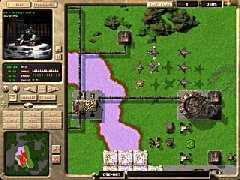 In addition, there is an in-depth report system that
gives you several different reports in order to manage your resources
better. There is a progress chart that monitors the status of your
colonies, and not only tells your success relative to the computer up
until now, but also predicts how the game will continue at the current
rate. This allows you, in battles whose victors are determined by colony
production, to determine what needs to be done to pull ahead (or bring
your opponent crashing down) before the end of the game. In addition, there is an in-depth report system that
gives you several different reports in order to manage your resources
better. There is a progress chart that monitors the status of your
colonies, and not only tells your success relative to the computer up
until now, but also predicts how the game will continue at the current
rate. This allows you, in battles whose victors are determined by colony
production, to determine what needs to be done to pull ahead (or bring
your opponent crashing down) before the end of the game.
Furthermore, there is a unit report that lets you toggle display of
armed units, air/sea/land units, buildings, etc. As a result, if I am
looking at a report and want to see how my offensive and defensive
buildings are doing, I just push the "structure" and "attack" buttons, and
all others disappear from the screen. In addition, I can choose other such
selections, such as which of my units need repairing or ammo, and monitor
the status of upgrades across my fleets. In short, this game is
overwhelming with the extent of customization it offers, and all is
intuitive and can be chosen with the push of a button. The only drawback
is that it does not save your view settings between levels, but since I
change options many times within one game, that did not have much of an
effect on me.
Gameplay
Another way in which M.A.X. manages to break the mold is that
in it, brute force is only one of many tools. Alone, it is totally
useless. In order to survive in M.A.X., scouting, surveying,
combining varied forces, positioning, and research are each just as
important, if not more so, than the "ogre/tank rush" tactic that has made
other games somewhat one-dimensional. You are able to create refineries
and research centers, which allow you to upgrade and enhance units, thus
creating a customized army. The game has eight different clans to choose
from, each with its own specific advantages and specialties. For instance,
one clan specializes in espionage, with a wider view range of improved
scouts and radar units, while another has stronger air units. This makes
for an incredibly wide range of playing styles, and quite frankly, I have
yet to see any "universal strategy."
M.A.X. introduces an element of gaming that is usually only
found in grognard-laden strategy brainfests -- supply chains. Each unit
has a limited amount of ammunition and strength, and so it is essential to
send out supply trucks, barges and repair units to keep an army going. If
a fleet of ships comes in on the attack and the defender brings in subs to
sink the resupply vessels following, a hasty retreat is in order. This
makes it so that a simple supply truck or repair bot can be a much more
valuable kill than a tank, fighter or escort.
Also, various units must be combined to prevent a dangerous Achilles'
heel. When I sent in a flotilla of missile cruisers or gunships, I always
had to mix in submarines (for both attack and defense), escorts (to shoot
down those nasty bombers), corvettes (not the fiberglass ones, but
specialized submarine spotting/killing ships), fighters (to help keep
other aircraft from mingling), an AWAC (to keep an eye in the sky),
bombers (to take out shoreline missile defenses that can cripple gunboats
and have longer ranges), and bushels of garlic to keep those pesky
vampires out (sorry, wrong game on that last one). No more bike rushes.
There is no superior unit, and combining forces is the way to go.
M.A.X. manages to transcend simple tactics and is the first game
of its kind that actually deserves to have the word "strategy" in its
title.
One of the other factors that sets M.A.X. apart from many
other similar games is the fact that it is turn-based. Now, to be honest
with you, if you look up the words "turn-based strategy" in my dictionary,
it gives a cross-reference to "boring." However, M.A.X. is
nothing of the sort. It offers a simultaneous turn-based mode, which is
very similar to real-time games, where both players are frantically moving
units at the same time. It is still turn-based since each unit has a
certain amount of movement or number of shots each turn. That way, you
can't simply dance a missile carrier in range, launch, and dance right
out. Many units require a certain amount of time to fire, thus putting
more realistic constraints on them. Also, this helps assure that in large
(and I mean very large in some cases) games, the computer, as well as your
quick thinking strategy devil of a friend, cannot take advantage of a
player that may be more skilled, but takes more time to move. The
simultaneous turn-based mode of M.A.X. strikes a delicate balance
between the hectic tactical action of Z and the
calculated scheming usually found in serious strategy games like Panzer
General.
Enemy AI
Although the AI has a few weaknesses (which are being addressed in the
next patch), it is a departure from most games of the genre. The AI is
both clever and unpredictable. I had a hard time preparing for an enemy
assault, since if I did the exact thing five times, the computer would
respond differently each time. No more predictability in enemy AI. If you
bring a flotilla of gunships with air cover to keep bombers away, the
computer will fly in a transport plane and drop anti-aircraft guns within
range, even if it means losing his transport in the process.
Also, instead of trickling in to attack one unit at a time, the
computer will scout around your base looking for a weak spot, and then
throw a sacrifice attack on the base, losing a few units but opening up a
hole in your defenses. I anticipate the newer patch, which strengthens the
AI further in custom games where the computer must start from scratch.
This is an area where many other games such as Red Alert have
suffered, and I am impressed at the dedication the M.A.X. team is
showing to improve non-essential features. Members of the development team
can be seen on Usenet, taking user feedback and responding to questions
and concerns.
Multiplayer Support/Experience
The multiplayer aspect of M.A.X. is even better than the
single play. If you get the game, be sure to download the 1.03 patch,
which solves some multiplay issues, along with a conflict with one of the
Matrox video cards. Although it does not officially support it,
M.A.X. can be played over the Internet through Kali. M.A.X. games support up to
four players, and the turn-based time limit will provide a compromise
between hectic commandos and slow deliberators.
 Graphics Graphics
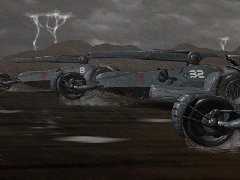
The graphics for M.A.X. are nothing short of superb. First of
all, the introduction and cut scene movies are wonderfully detailed and
arguably one-up even those of Red Alert. In addition, all units,
buildings, and scenery are pre-rendered in high detail, so they are
displayed very crisply at any zoom level. In fact, I often found myself
zooming in on a particular unit in the middle of a strategic maneuver just
to see how menacing it looked, and usually it looked sufficiently so,
thanks to the M.A.X. team's attention to detail. All units cast
shadows, including planes, and the unit information window (which I
enjoyed in Warcraft II and sorely missed in Red Alert)
even lets you choose to view a still or animated shot of the unit. A minor
detail, but another example of how refined this game is, even down to the
smallest details.
Audio
The audio in this game is as good as would be expected. All units have
their own respective sounds, and as with the rest of the interface, the
female voice that gives messages and reports status is well used, keeping
you informed without getting in the way. In addition, the soundtrack is
excellent, a nice break from the overabundance of techno music in recent
games. The songs all have somewhat of a music-noir quality to them, as if
they belong in Blade
Runner or Akira. Even if you
don't like the music, it, like everything else in this game, is
customizable and can be turned down or toggled off if desired.
System Requirements
PC with 486/66+ CPU, 8 MB RAM, 2X CD-ROM drive, 16-bit SoundBlaster or
compatible sound card, SVGA video card required, mouse required.
Note that in order to achieve playable speed on a 486, you will
probably want to do a medium or full install, which takes about 300 MB of
hard drive space. On the other hand, the movies are as smooth as silk that
way!
Documentation
The manual for M.A.X. is excellent. Even though I had a hard
time tearing myself away from the game to read it, the documentation
provides an excellent range of information on rules, features and units.
In fact, this is one of the few strategy action games that actually sits
you down at the very beginning and gives you all the numbers ahead of
time. As a result, you know how much you need to reinforce a scout bike in
order to have it survive an attack by an assault gun, and you know how
many gunboats you need to bring along in order to take out his shipyard
(that is, if his subs don't find you first!). Not only is the manual
excellently detailed, but the game itself presents all stats about a unit,
and if you want more information, right-clicking on a selected unit brings
up a help page with both statistics and a description of the unit, its
purpose, strengths, and weaknesses.
Also well done are the tutorial missions, which take you through one
concept or unit type at a time, without being condescending. I would
highly recommend playing them through first before getting into the real
game, since they will teach you a lot about the interface, units,
features, and other concepts necessary to play the game. In addition, they
will also save you a bucketload of butt-kicking (with you on the receiving
end, of course). Once you have graduated from the tutorial missions, you
will spend a lot less time in the on-line help and a lot more time handing
out the beat-down.
Bottom Line
M.A.X. is a phenomenal game. I don't want to slight other
great games (which I compared this game to liberally), but M.A.X.
is more refined, more strategy-oriented, and simply more fun than any of
its big brothers. Not only are the individual missions big (and often
long), but between the tutorial missions, single play campaign, custom
campaigns, individual missions and multiplay, this is by far the biggest
game of its kind. Trust me -- you will not just whiz through this game. I
would almost have expected many of the included levels (either the
individual levels or the custom scenarios) to be provided as an add-on for
the game, because they are so extensive.
I had a few minor complaints, but Interplay has already addressed most
of them in the 1.03 patch,
and is in the process of fixing the others. All in all, this is the game I
would have wanted to make if I could actually make a decent game. It will
provide many hours of entertainment for anyone that enjoys either
turn-based or real-time strategy, and raises the ante for all the
Warcraft 2 and C&C wannabes out there. In fact, I
wonder how long it will be before we see M.A.X. wannabes? Hmm …
While I'm pondering that one, go out and get this game. It is one of the
rare beauties of a game where someone got rid of the marketing team and
actually made a straightforward, flexible, exciting, extensive and
refreshing game. This is one of the few games that breaks the 90 barrier,
and if I had started playing the game after the patch came out, I would
have given it even higher. This game gets a 94/100 -- it is honestly that
good. |




